Consulting & Design Services

Design It Right the First Time. Or Pay for It Forever.

Poor warehouse design costs you every single day — in wasted steps, missed capacity, and projects that never hit ROI. We bring 500+ facility designs to your planning table, so you build what actually works.
Precision Integrators logomark in white
Master Planning That Scales
Your facility needs to work today and five years from now. Our master planning process maps your growth trajectory, operational requirements, and automation readiness—so you're not redesigning every time the business changes.

We factor in what most planners skip: seasonal peaks, SKU proliferation, future automation hooks, and the regulatory landscape. The result? A roadmap that scales with you.
Learn More
Learn More
Large-scale warehouse storage system with organized pallet racking
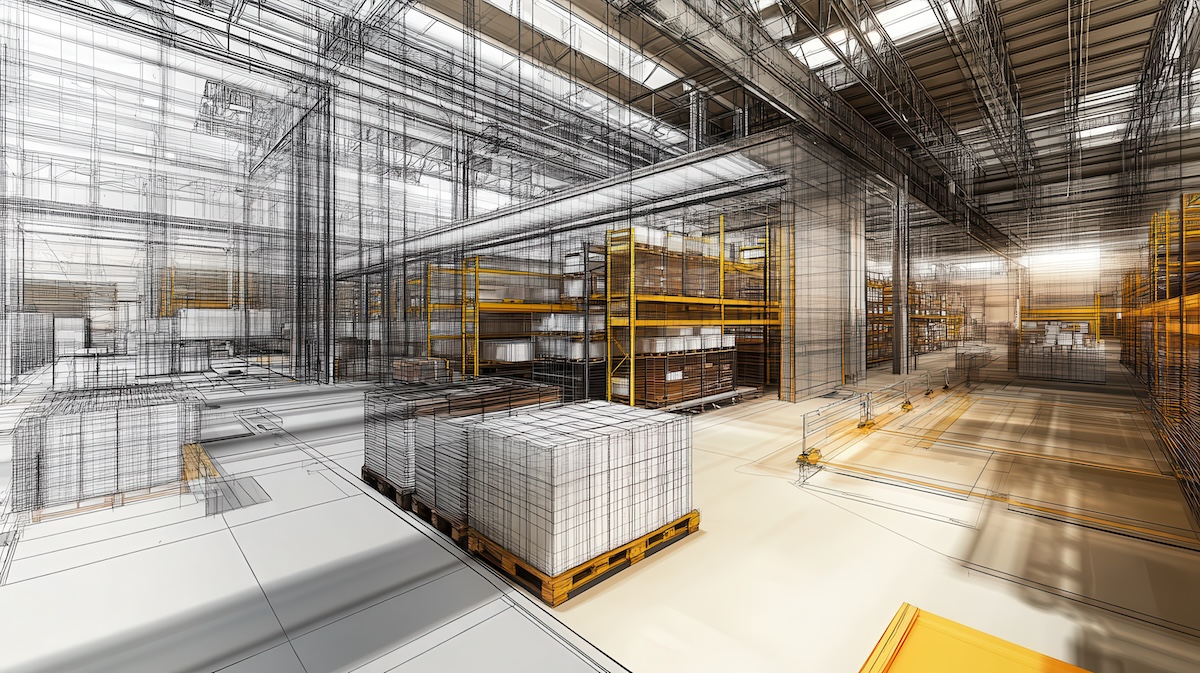
3D Simulation Before You Build
See your warehouse run before you spend a dollar on construction. Our simulation modeling tests throughput, identifies bottlenecks, and validates your design with real operational data—not spreadsheet assumptions.

Simulation typically reveals 15-30% efficiency improvements that would have been invisible until go-live. We'd rather find problems in the model than in the concrete.
Learn More
Learn More
Star iconStar iconStar iconStar iconStar icon
Rated 4.9/5 from 500+ successful facility projects
Every Detail Designed. Every Decision Documented.
From site assessment to final permit, we handle the complexity so you can focus on operations.
Request a Design Consultation
Site Assessment & Analysis
Before we design anything, we understand everything. Our assessment covers building constraints, utility access, traffic patterns, code requirements, and operational workflows. Data in, insights out.
CAD & 3D Modeling
Every design delivered in detailed CAD with 3D visualization. Walk through your future facility, identify issues early, and give stakeholders something real to approve—not abstract blueprints.
Throughput Simulation
Test your design under real-world conditions before construction begins. Our simulation models run your actual order profiles, seasonal peaks, and labor scenarios to validate—or improve—every layout decision.
Permitting & Code Compliance
We navigate jurisdictional requirements, fire codes, seismic standards, and ADA compliance before you file. Our permit packages pass inspection the first time—because rework is expensive and delays are worse.
Equipment Specification
Vendor-agnostic recommendations for racking, conveyors, lifts, and automation. We spec what works best for your operation—not what earns us the biggest margin. Complete BOMs with budgetary pricing.
Implementation Planning
Your design includes a phased implementation roadmap—sequenced to minimize disruption and maximize momentum. We plan the work so you can work the plan without surprises.
Compare Precision
What makes our project Approach different?
Precision Integrators
Capability
Typical Consultant
Site Assessment
Check icon
Comprehensive (building, ops, growth)
Check icon
Basic measurements
3D Visualization
Check icon
Full 3D walkthrough
Cross icon
2D drawings only
Throughput Simulation
Check icon
Data-driven modeling
Cross icon
Spreadsheet estimates
Permitting Support
Check icon
Full documentation & filing
Cross icon
"That's your GC's job"
Vendor Independence
Check icon
Recommend best-fit equipment
Cross icon
Push preferred vendors
Implementation Support
Check icon
Stay through go-live
Cross icon
Deliver drawings, disappear
Ongoing Accountability
Check icon
Your partner long-term
Cross icon
Project ends at design

Not Sure Where to Start?

Whether you're planning a new facility, retrofitting an existing space, or just trying to understand your options—let's talk. No pitch, no pressure. Just clarity on your next move.
common questions
We’re here to answer your questions.
Prospect evolves with you, learning your patterns and pushing what’s next into now.
What's included in your initial site assessment?
Chevron down icon
Our assessment covers building dimensions and constraints (clear height, column spacing, floor load capacity), existing infrastructure (utilities, fire suppression, dock configuration), operational workflows (receiving, storage, picking, shipping), growth projections, and code/permitting requirements specific to your jurisdiction. You'll receive a detailed report with findings and recommendations.
How long does the design process typically take?
Chevron down icon
Timeline depends on scope. A straightforward storage layout for an existing facility might take 2-3 weeks. A comprehensive greenfield design with simulation and permitting support typically runs 6-12 weeks. We'll give you a specific timeline during our initial consultation.
Do you design for both new construction and existing facilities?
Chevron down icon
Yes. About 60% of our projects are retrofits or optimizations of existing facilities, and 40% are greenfield (new construction) designs. Each requires different approaches—retrofits must work within existing constraints, while greenfield projects can optimize from scratch.
What information do you need from us to get started?
Chevron down icon
We'll need building drawings or dimensions, current inventory data (SKU count, velocity, dimensions), order profiles (volume, lines per order, shipping methods), growth projections, and any specific operational requirements or constraints. Don't worry if you don't have everything—we'll identify gaps during our initial consultation.
What's the difference between CAD drawings and 3D simulation?
Chevron down icon
CAD drawings show the physical layout—rack locations, aisle widths, dock positions. Simulation goes further: it runs your actual operational data through the design to test throughput, identify bottlenecks, and validate performance before you build. Think of CAD as the blueprint and simulation as the stress test.
How accurate are your throughput simulations?
Chevron down icon
Our simulations use your actual data—order profiles, seasonal patterns, labor assumptions—so accuracy depends heavily on data quality. With good input data, simulations typically predict real-world performance within 5-10%. More importantly, they reveal relative improvements between design options, helping you make informed decisions.
Do you provide equipment recommendations, or just layouts?
Chevron down icon
Both. Every design includes equipment specifications—racking systems, material handling equipment, automation components—with budgetary pricing. We're vendor-agnostic, so recommendations are based on what works best for your operation, not vendor relationships.
Can you help us plan for future automation even if we're not implementing it now?
Chevron down icon
Absolutely. We call this "automation readiness." Even if today's budget only covers racking and forklifts, we design with future automation hooks—floor flatness specs, power drops, communication infrastructure, and layout configurations that won't require complete redesign when you're ready to automate.
Do you handle permitting, or is that our responsibility?
Chevron down icon
We handle permitting support—preparing all required documentation, engineering calculations, and drawings to code. We work directly with local authorities having jurisdiction (AHJs) and attend inspections when needed. You sign the permit applications, but we do the work.
What happens if our permit gets rejected?
Chevron down icon
Rejections are rare when we handle permitting—our documentation is thorough and we know jurisdictional requirements. But if issues arise, we address them immediately at no additional cost. We don't consider the design complete until permits are approved.
How do you handle design changes during implementation?
Chevron down icon
Changes happen—that's reality. We build flexibility into our designs and stay engaged through implementation. Field conditions might require adjustments, and we make those modifications quickly without starting a change-order negotiation every time.
Do you work with our general contractor and other trades?
Chevron down icon
Yes. We coordinate with your GC, electricians, fire protection contractors, and equipment vendors. Clear communication between trades is essential for smooth implementation, and we serve as the single point of coordination for all warehouse systems.