Conveyor systems move product through your warehouse faster than any manual process can. But "conveyor" covers a lot of ground. The system that works perfectly for an e-commerce fulfillment center sorting thousands of small parcels won't work for a manufacturer moving pallets between production lines.
Choosing the right conveyor type starts with understanding what each system does well, where it struggles, and what your operation actually needs it to accomplish.
This guide breaks down the major conveyor categories, explains when each makes sense, and helps you think through the selection process based on your specific requirements.
The Two Fundamental Categories: Powered vs. Gravity
Before diving into specific conveyor types, understand the basic distinction that shapes every system.
Powered conveyors use motors to move product. They control speed, can move items uphill, and operate independently of product weight. They cost more to buy and maintain but offer precise control.
Gravity conveyors use decline angles and product weight to create movement. No motors, minimal maintenance, lower cost. But they only move product downhill (or require manual pushing on flat surfaces), and speed varies with product weight.
Most warehouse conveyor systems combine both. Powered conveyors handle the work that requires control and consistency. Gravity sections handle simple point-to-point movement where motors aren't necessary.
Belt Conveyors
Belt conveyors use a continuous loop of material (rubber, PVC, fabric, or other materials) running over pulleys to transport product. The belt provides a solid, continuous surface that contacts the product directly.
Best applications:
- Small or irregularly shaped items that would fall between rollers
- Fragile products requiring gentle handling
- Bagged or soft goods that conform to surfaces
- Inclines and declines (the belt grips the product)
- Scan tunnels and other applications requiring precise positioning
- Items with uneven or soft bottoms
Advantages:
- Full product support across the entire surface
- Consistent speed regardless of product weight
- Handles a wide variety of product shapes and sizes
- Excellent for inclines (with proper belt material)
- Maintains product orientation and position
Limitations:
- Higher initial cost than roller conveyors
- Belt replacement can be expensive
- Less modular (harder to reconfigure)
- Not ideal for very heavy loads
- Requires more maintenance than gravity systems
When to choose belt: When you need precise control of product position, when products are small or fragile, when you're conveying on inclines, or when products don't have flat, rigid bottoms.
Roller Conveyors
Roller conveyors use a series of cylindrical rollers mounted on axles to move product. Items ride on top of the rollers. There are several variations:
Gravity Roller Conveyors
The simplest type. Rollers spin freely, and product moves by gravity on a slight decline (typically 3-5 degrees) or by manual push on flat sections.
Best applications:
- Loading and unloading trucks
- Temporary or portable workstations
- Accumulation areas
- Short runs between powered sections
- Budget-conscious applications
Advantages:
- Low cost (no motors or controls)
- Minimal maintenance
- Easy to reconfigure or relocate
- No power required
Limitations:
- Only works downhill or with manual push
- Speed varies with product weight
- Heavy items can accelerate dangerously
- Light items may not move consistently
- Requires flat-bottomed products
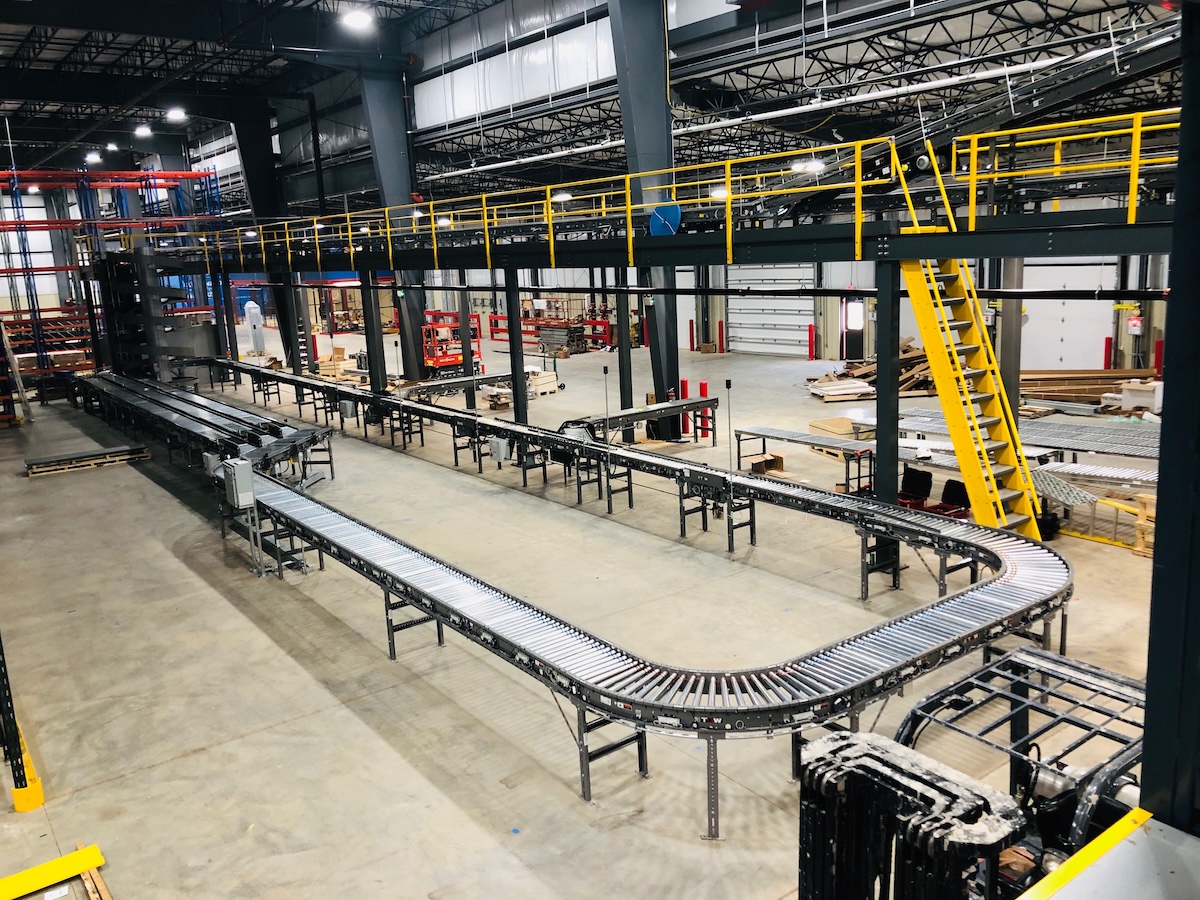
Powered Roller Conveyors (Live Roller)
Rollers are driven by motors through belts, chains, or direct drive. Product moves at controlled speeds regardless of weight.
Subtypes include:
Belt-driven live roller (BDLR): A continuous belt underneath the rollers provides power. Common, reliable, moderate cost.
Chain-driven live roller (CDLR): Chains connect the rollers. Handles heavier loads. Often used for pallet conveying.
Line shaft: A single rotating shaft runs the length of the conveyor, with bands connecting it to individual rollers. Good for long runs at consistent speeds.
Best applications:
- Flat-bottomed cartons and totes
- Pallet handling (chain-driven)
- Long transportation runs
- Areas requiring curves and merges
- Applications where operators interact with product on the conveyor
Advantages:
- Lower cost than belt conveyors
- Handles heavy loads well
- Easy access between rollers for pop-up devices, transfers, etc.
- Individual rollers can be replaced without affecting the whole system
- Good for curves and merges
Limitations:
- Products need flat, rigid bottoms
- Small items can fall between rollers
- Speed varies somewhat with product weight (less than gravity, but present)
- Not ideal for fragile items or bags
- Noisier than belt conveyors
When to choose roller: When you're moving standard cartons, totes, or pallets with flat bottoms, when budget matters, when you need curves and merges, or when operators will interact with product on the line.
Motor Driven Roller (MDR) Conveyors
MDR conveyors deserve their own section because they've transformed warehouse conveyor systems over the past two decades.
Instead of external motors powering belts or chains, MDR systems have small 24-volt DC motors built directly into individual rollers. Each motor roller powers a zone of 2-6 additional "slave" rollers. Zones are controlled independently by logic cards.
Key feature: Zero Pressure Accumulation (ZPA)
MDR systems excel at accumulation. Products stop in zones without touching each other. When downstream space opens up, zones release products one at a time. No contact, no pressure, no product damage.
Best applications:
- Order fulfillment and picking operations
- Anywhere products need to accumulate without touching
- E-commerce warehouses with variable throughput
- Applications requiring energy efficiency
- Areas where quiet operation matters
Advantages:
- Zero pressure accumulation prevents product damage
- Energy efficient (zones only run when needed, potential 50-70% savings vs. conventional)
- Quiet operation (no chain noise, no constantly running motors)
- Safe (24V DC is low voltage, low torque)
- Modular and easy to reconfigure
- Simple maintenance (replace individual rollers, not entire drives)
Limitations:
- Higher upfront cost than conventional powered roller
- Lower torque than chain-driven systems (not ideal for very heavy loads)
- More complex controls
- Motor rollers cost more to replace than standard rollers
When to choose MDR: When you need accumulation without product contact, when energy costs matter, when quiet operation is important, or when flexibility to reconfigure is valuable.
Accumulation Conveyors
Accumulation is a function, not a conveyor type. But it's important enough to address directly.
Accumulation conveyors temporarily hold products in queue, allowing downstream processes to catch up. Without accumulation, a slowdown anywhere in the system backs up the entire line.
Types of accumulation:
Minimum pressure accumulation: Products touch each other and create some back-pressure. Simple and inexpensive, but can damage products or cause jams. Usually belt or line-shaft driven.
Zero pressure accumulation (ZPA): Products stop in zones without touching. MDR systems do this natively. Other systems use pneumatic controls or photo-eye sensors to achieve similar results.
When accumulation matters:
- Variable-rate processes (scanning, labeling, packing) that create temporary slowdowns
- Merging multiple lines into one
- Buffering between automated and manual processes
- Any system where throughput varies
If your operation has any variability in processing rates, you need accumulation somewhere in the system. The question is how much and what type.
Sortation Conveyors
Sortation systems divert products to different destinations based on criteria like order number, destination, product type, or shipping method. They're the decision-makers in a conveyor system.
Pop-Up Wheel Diverters
Rows of angled wheels rise up through a roller conveyor bed to divert products to a side lane. When not diverting, the wheels drop below the rollers and products pass straight through.
Best for: Medium-speed applications, flat-bottomed cartons, budget-conscious projects Throughput: Up to 30-60 cartons per minute Cost: Lower end of sortation systems
Narrow Belt Sorters
Multiple narrow belts transport products. Pop-up rollers between the belts divert items at 30 or 90 degrees.
Best for: Small to medium cartons, medium throughput Throughput: Up to 175 cartons per minute Cost: Moderate
Sliding Shoe Sorters
A bed of aluminum slats with plastic "shoes" mounted on them. When diverting, shoes slide across the slats to gently push products off the conveyor at an angle (typically 22 or 30 degrees).
Best for: Cartons and packages of varying sizes, fragile items requiring gentle handling, high-volume distribution Throughput: Up to 200-300 cartons per minute Cost: Mid-to-high range Advantage: Very gentle, handles a wide range of product sizes
Crossbelt Sorters
Individual carriages with short belt conveyors travel on a continuous loop. Products load onto the belts, travel to their destination, and the belt activates to discharge the product sideways.
Best for: High-speed sorting, small items, e-commerce fulfillment, mixed product sizes Throughput: Up to 400-500+ items per minute Cost: High Advantage: Handles irregular shapes, soft goods, and items that other sorters struggle with
Tilt Tray Sorters
Similar to crossbelt, but carriages hold tilting trays instead of belts. Trays tilt to slide products off using gravity.
Best for: Small items, apparel, returns processing Throughput: Slightly lower than crossbelt (fewer moving parts) Cost: Lower than crossbelt Advantage: Simpler mechanics, lower maintenance
Choosing a sortation method: The decision depends on throughput requirements, product characteristics, number of sort destinations, and budget. Lower-volume operations may do fine with pop-up wheels. High-volume e-commerce typically needs shoe sorters or crossbelt systems.
Specialty Conveyors
Several conveyor types serve specific applications:
Spiral Conveyors
Move product vertically (up or down) in a continuous helix. Save floor space compared to incline conveyors that require long horizontal runs.
Use when: You need to change elevation in a limited footprint.
Vertical Reciprocating Conveyors (VRCs)
Essentially freight elevators for product. A platform moves vertically between levels, carrying product up or down.
Use when: Moving product between mezzanine levels or floors, especially for pallet-sized loads.
Extendable/Telescoping Conveyors
Conveyors that extend into truck trailers for loading or unloading. Collapse when not in use.
Use when: Loading/unloading trucks is a significant part of your operation.
Flexible Conveyors
Gravity conveyors (usually skate wheel or roller) on flexible frames that can extend, curve, and collapse. Portable and reconfigurable.
Use when: You need temporary or frequently reconfigured conveyor runs, especially for truck unloading.
Matching Conveyors to Your Operation
The right conveyor depends on what you're moving, how fast, and what needs to happen along the way.
Product Characteristics
What are you moving?
- Cartons with flat bottoms → Roller conveyors work well
- Bags, soft goods, or irregular shapes → Belt conveyors
- Small items that could fall between rollers → Belt conveyors
- Heavy pallets → Chain-driven roller conveyors
- Mix of everything → Combination of types in different zones
How fragile is the product?
- Very fragile → Belt conveyors, ZPA accumulation, gentle sortation (shoe or crossbelt)
- Standard packaging → Most conveyor types work
How heavy?
- Light to medium (under 50 lbs) → Belt or standard roller
- Heavy (50-100+ lbs) → Heavy-duty roller, chain-driven
- Pallets (1,000+ lbs) → Chain-driven live roller or pallet-specific systems
Throughput Requirements
How many units per minute?
- Low (under 20/minute) → Simple systems, possibly manual assistance
- Medium (20-100/minute) → Standard powered conveyors, pop-up sortation
- High (100-300/minute) → Engineered systems, shoe sortation
- Very high (300+/minute) → Crossbelt or tilt tray sortation, high-speed induction
Operational Needs
Do products need to accumulate?
- Minimal accumulation → Standard conveyors with some buffer zones
- Significant accumulation → MDR or dedicated accumulation conveyors
- Products can't touch → Zero pressure accumulation (MDR)
Do products need to be sorted?
- Few destinations → Simple diverters or manual
- Many destinations, moderate speed → Pop-up or narrow belt
- Many destinations, high speed → Shoe, crossbelt, or tilt tray
Do operators interact with the conveyor?
- Picking from conveyor → Roller conveyors allow easier access
- Pack stations → Accumulation before stations prevents starvation
- Scanning/labeling → Belt conveyors maintain product position
Facility Constraints
What space is available?
- Long straight runs → Line shaft or standard powered roller
- Tight curves → MDR or belt curves
- Elevation changes → Incline belts, spirals, or VRCs
- Limited floor space → Overhead conveyors, spirals, or mezzanine integration
What infrastructure exists?
- Limited power → Consider gravity where possible
- Existing conveyor → Match types for integration
- Future expansion planned → Modular systems (MDR) ease changes
Integration Considerations
Conveyors don't operate in isolation. Consider how they connect to:
WMS/WCS: Modern conveyor systems communicate with warehouse management and control systems. Sortation especially requires integration to know where to send each item.
Existing equipment: New conveyors need to interface with current processes, whether that's manual stations, automated equipment, or existing conveyor.
Future automation: If you're planning to add robotics, AS/RS, or other automation later, choose conveyors that can integrate with those systems.
Maintenance capabilities: More sophisticated systems require more sophisticated maintenance. MDR is easier to maintain than older chain-driven systems, but still requires trained technicians.
Common Mistakes to Avoid
Overbuilding for current needs. A system designed for 500 cartons per minute when you're doing 100 wastes money. Build for realistic growth, not fantasy scenarios.
Underestimating accumulation needs. Every process has variability. Systems without adequate accumulation jam when anything slows down.
Ignoring product variability. A conveyor perfect for your standard carton may fail with that occasional oversized or oddly shaped item. Design for the exceptions.
Choosing sortation speed over accuracy. A faster sorter that missorts 2% of products creates more work than a slower one with 99.9% accuracy.
Forgetting about maintenance. The cheapest system to buy may be the most expensive to maintain. Consider total cost of ownership.
Skipping the integration planning. Conveyors that don't talk to your WMS require manual intervention at every decision point.
Making the Decision
Start with your operation, not the technology.
Define what you're moving, how fast, and what needs to happen to it along the way. Map the flow from receiving to shipping. Identify where products need to accumulate, merge, sort, or change direction.
Then match conveyor types to each section of that flow. Most systems use multiple conveyor types, each selected for its specific zone's requirements.
The goal isn't the most sophisticated system. It's the right system for your operation, your products, and your growth trajectory.
Frequently Asked Questions
What's the difference between belt and roller conveyors?
Belt conveyors use a continuous surface to support and move products, providing full support and consistent speed. Roller conveyors use a series of rotating cylinders that products ride on top of. Belt conveyors handle irregular shapes and fragile items better. Roller conveyors cost less, handle heavy loads well, and allow easier integration of diverters and transfers.
When should I use gravity conveyors vs. powered conveyors?
Gravity conveyors work well for moving products downhill over short distances, loading/unloading trucks, and temporary or portable applications. They're low cost with minimal maintenance. Use powered conveyors when you need controlled speeds, uphill movement, consistent flow regardless of product weight, or integration with automated systems.
What is zero pressure accumulation?
Zero pressure accumulation (ZPA) allows products to queue on a conveyor without touching each other. When downstream space is full, products stop in individual zones with gaps between them. When space opens up, they release one at a time. ZPA prevents product damage from contact and back-pressure. MDR conveyor systems provide ZPA natively through zone-controlled motor rollers.
How do I choose the right sortation system?
Consider throughput requirements (how many items per minute), product characteristics (size, weight, fragility), number of sort destinations, and budget. Pop-up wheel diverters work for lower speeds and budgets. Shoe sorters handle medium-to-high speeds gently. Crossbelt and tilt tray sorters provide the highest speeds and handle the widest variety of products but cost the most.
What conveyor works best for e-commerce fulfillment?
E-commerce typically requires systems that handle variable product sizes, support order accumulation, and integrate with sortation. MDR conveyors are popular for their zero-pressure accumulation, energy efficiency, and modularity. Belt conveyors work well for small items and polybags. Crossbelt or shoe sorters handle high-volume order routing to pack stations.